For the better part of a decade, grey ruled the kitchen. Cool-toned cabinets, icy quartz, white-on-white palettes — designers leaned in, homeowners followed, and the look became synonymous with “modern.”
In 2026, that chapter is closing. Designers across the country are reporting overwhelming client demand for warmth, texture, and natural materials. The pendulum has swung.
What’s Replacing Grey
The defining shift is toward warm, grounded interiors that feel personal rather than performative. A few themes we’re tracking:
- Warm wood tones — oak, walnut, cherry, and ash with honey and caramel undertones are leading the year.
- Mixed wood species — the rule that all wood must match is gone. Layering light and mid-tone woods adds depth and character.
- Earthy color palettes — warm creamy whites, mushroom, taupe, deep olive, and terracotta are replacing icy greys and stark whites.
- Modern Heritage — inset cabinetry, classic profiles, and traditional millwork details paired with contemporary finishes.
- Tactile, handcrafted detail — fluted panels, reeded fronts, and visible grain are doing the visual work that bold color used to do.
The White Oak Problem
There’s a catch. White oak is the wood everyone wants in 2026 and the market knows it. Industry data shows white oak now carries a 20% – 35% premium over comparable species like maple or red oak, with semi-custom white oak cabinetry running $800–$1,100 per linear foot and rift-sawn custom work pushing past $1,400.
For designers working to a budget, that math doesn’t always pencil out.
The good news: several alternatives deliver the same warm, neutral, modern look at meaningfully lower cost.
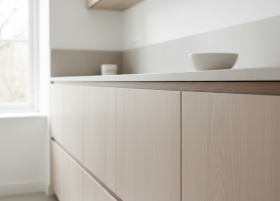
Smart Alternatives to White Oak
Red Oak (Reimagined)
Part of the same species family, red oak remains one of the most cost-effective alternatives. With modern finishing techniques, it can be toned to read surprisingly close to white oak—particularly in mid-tone and darker palettes.
The grain is more pronounced and cathedral-driven, which many designers are now choosing to highlight rather than conceal.
Best use:
Projects where budget matters, but visible grain is still desired.
White Ash
An underutilized standout. White ash offers a straight, open grain structure very similar to white oak, with a naturally light tone and excellent stain absorption.
It consistently delivers the closest visual match to white oak while typically coming in at a lower material cost.
Best use:
When the goal is to replicate the white oak look as closely as possible without the premium.
Quarter-Sawn Hickory
A more expressive option. Quarter-sawn hickory introduces greater variation, movement, and natural warmth compared to white oak.
While it can land in a similar price tier depending on sourcing, it delivers a distinctly more dynamic visual.
Best use:
Designs that benefit from character and contrast rather than restraint.
White Oak Veneer (Engineered Approach)
For flat-panel doors, slab cabinetry, and large millwork applications, white oak veneer over engineered substrates is often the most efficient solution.
It provides the visual continuity of white oak with significantly improved material yield and cost control. When executed properly, it is virtually indistinguishable from solid stock.
Best use:
Large-scale cabinetry runs, modern slab doors, and projects requiring consistency and efficiency.
What This Means for Your Next Project 👇
The takeaway isn’t to avoid white oak — it’s still beautiful, durable, and a worthy investment when the budget allows. The takeaway is that designers and homeowners now have real options. A thoughtful species swap, a strategic veneer application, or a well-chosen stain can deliver the 2026 look without forcing a budget conversation that derails the project.
At Wainscot Solutions, we work with designers and builders to spec the right material for the right application — and to be straight with you when there’s a smarter way to get the look your client wants.
If you have a project on the horizon and want to talk through species, finishes, or budget tradeoffs, we’d love to hear from you!