


White oak has become one of the most requested species in custom cabinetry and millwork – and for good reason. It’s warm, light tone, open grain, and natural durability make it a strong choice across a wide range of design styles, from transitional to contemporary. But not all white oak is the same. The way a log is cut at the mill determines the grain pattern, dimensional stability, and ultimately, the cost of the material you are specifying.
If you have ever noticed a significant price gap between two white oak quotes, this is likely the reason. Understanding the 3 primary cuts – plain slice, quarter sawn, and rift cut – will help you specify the right material for each project and give your clients a clear rationale for the investment.
The Three Cuts: What They Are and What They Look Like
Plain Slice (Also Called Flat Cut) $
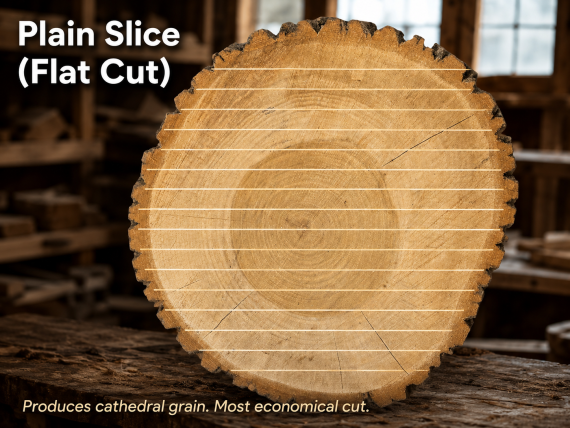

Plain slice is the most common and most economical cut. The log is sliced parallel to its center, producing the familiar arching or cathedral grain pattern most people associate with wood. It is widely available, yields the most usable material from a log, and carries the lowest price point of the three cuts.
The trade-off is dimensional stability. Plain slice lumber and veneer has a higher tendency to cup, bow, and move with seasonal humidity changes. For applications where grain is not the focal point, it is often a practical and cost-effective choice.
Quarter Sawn White Oak $$$
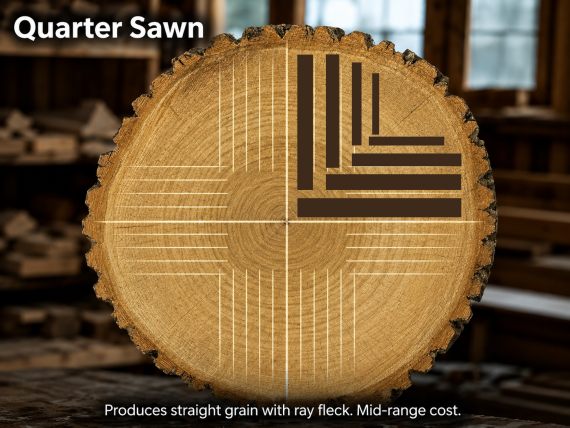
Quarter sawn lumber is produced by first quartering the log lengthwise, then sawing boards perpendicular to the growth rings. This process yields a tighter, straighter grain pattern and (the feature that makes it visually distinctive in white oak specifically) prominent medullary ray fleck. These are the silvery, irregular streaks that appear on the face of the board, produced by the wood rays running through the center of the tree.
Quarter sawn white oak is more dimensionally stable than plain slice, and the ray fleck is a prized aesthetic characteristic in furniture, craftsman-inspired design, and high-end cabinetry. It commands a higher price than plain slice due to reduced yield from the log and the additional milling steps involved.
Rift Cut White Oak $$$$$
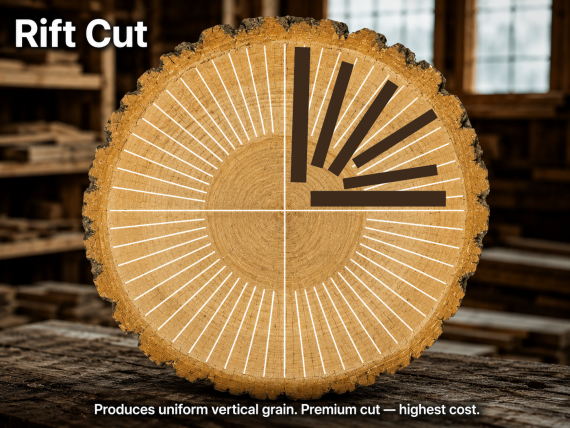
Rift cut is THE luxury cut. The log is sawn at an angle of approximately 30 to 60 degrees to the growth rings, which produces boards with grain lines that run nearly parallel to the face of the board: resulting in clean, consistent vertical lines with no cathedral figure and minimal to no ray fleck.
➡️ The result is a highly uniform, linear grain appearance that reads as refined and contemporary.
Rift cut is also the most dimensionally stable of the three cuts, making it the preferred specification for flush inset cabinetry, long drawer faces, and any application where grain consistency across multiple panels is critical.
So, Why Is Rift Cut White Oak So Expensive?
This is the question designers hear most often from clients reviewing a white oak quote. The answer comes down to three interconnected factors: yield, labor, and demand.
- Poor Log Yield
Rift cutting produces significantly less usable lumber per log than plain slicing. The angled sawing technique eliminates much of the material that would otherwise become flat-sawn boards. Estimates vary by log and operation, but rift cut yield from a log is often half or less of what flat sawing produces. That waste cost is absorbed into the price of every board that makes it to market.
- Increased Milling Complexity
Achieving consistent rift cut angle across the width of a board requires more precise and time-intensive milling than straight flat sawing. The log must be repositioned repeatedly as it is processed. This adds equipment time, operator skill, and labor cost at the mill — before the wood ever arrives at a shop like ours.
- Strong Market Demand from Design Professionals
The demand for rift cut white oak has grown considerably alongside the popularity of clean-lined, natural material aesthetics in residential and commercial design. Interior designers, architects, and high-end builders consistently specify it for custom cabinetry, built-ins, and millwork. High demand for a limited-yield product means premium pricing — and that gap has widened in recent years.
How We Recommend Presenting the Rift Cut Cost to Your Client
For designers and builders presenting a rift cut specification to a client, the upcharge is most easily justified when tied to specific performance and aesthetic outcomes rather than material cost alone. Here is a straightforward framing that works well:
- Grain consistency across panels.
Rift cut produces nearly identical grain lines from panel to panel. In a run of cabinetry with multiple doors and drawer faces, this creates a cohesive, intentional appearance that flat-cut oak cannot reliably replicate.
- Long-term dimensional stability.
Rift cut white oak is far less prone to movement, cupping, and telegraphing over time. In flush inset cabinet doors, where tolerances are tight and gaps must remain consistent, this is not a cosmetic consideration. It is a functional one.
- The finished product reflects the specification.
When clients see rift cut white oak finished and installed, the clean linear grain reads as a deliberate, high-quality choice. It photographs well, ages gracefully, and holds its design intent for decades.
- It is NOT a standard, readily available grade.
Rift cut white oak is NOT commonly stocked at home centers or mass-market cabinet suppliers. It is a trade-sourced material that requires a custom shop with the relationships, equipment, and finishing expertise to handle it correctly.
Working with Rift Cut White Oak at Wainscot Solutions
Wainscot Solutions regularly works with rift cut white oak for custom cabinetry, built-ins, and architectural millwork across Fairfield County CT, Litchfield County CT, and Westchester County NY. We source material through established trade suppliers and handle all in-house finishing, allowing us to control grain matching, stain consistency, and final quality from raw stock through installation.
If you are specifying white oak for an upcoming project and want to discuss cut options, pricing, and lead times, reach out to us directly. We are happy to walk through material options with you and your client.